
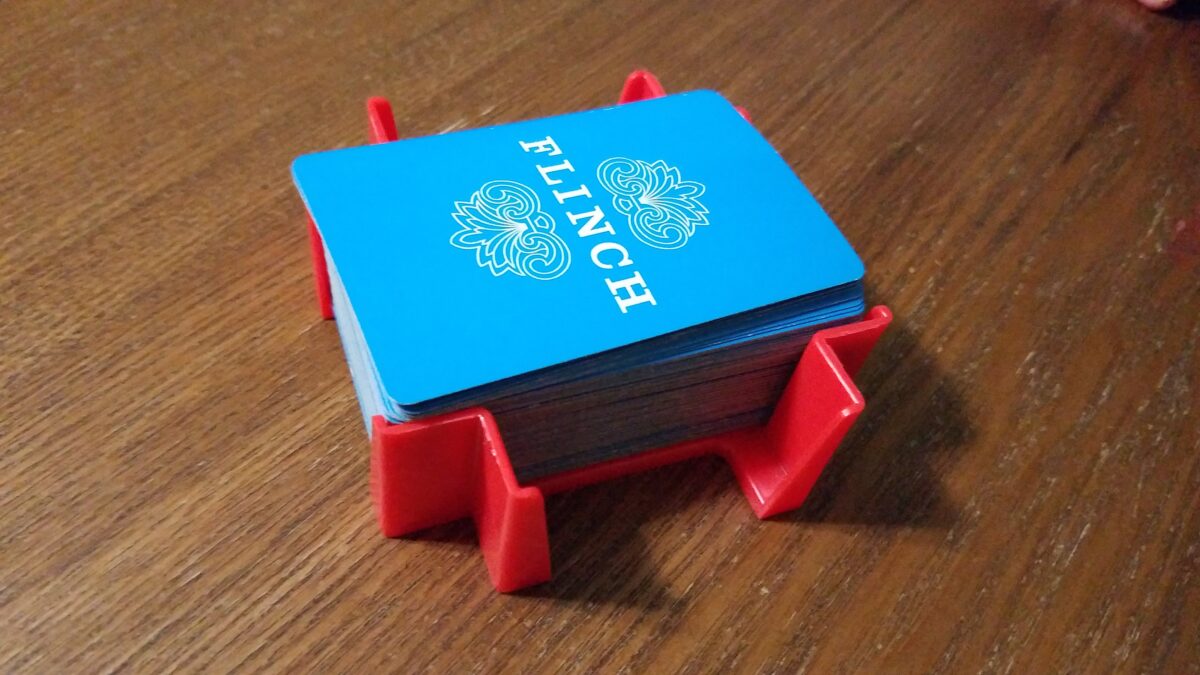
Flinch is a sequencing card game where you race to empty a face-down stack of ten cards called your stockpile, playing them in order from 1 up to 15. Two to eight people can play, and a seven-year-old can pick it up in about five minutes. It is one of the earliest commercial stockpile card games, and if you have ever played Skip-Bo, you already know roughly ninety percent of it.
That last point matters more than most write-ups admit. Skip-Bo, Spite and Malice, and Dutch Blitz all sit on the same mechanical skeleton, and Flinch got there before any of them. So when people call Flinch “the original,” they are not being sentimental about an old box — they mean the design genuinely predates the games most of us learned first.
Game Overview at a Glance
| Players | 2–8 (sweet spot is 2–4) |
| Age | 7 and up |
| Playtime | 20–40 minutes |
| Deck | 150 cards (classic) or 144 cards (modern Winning Moves) |
| Designer | Arthur J. Patterson |
| Current publisher | Winning Moves Games USA |
| Type | Stockpile / sequencing card game |
A quick word on player count. The box happily says up to eight, but the experience changes a lot past four. With five or six the table fills with reserve piles and downtime stretches, which is exactly why the modern wild-card version exists — more on that below.
What’s in the Deck
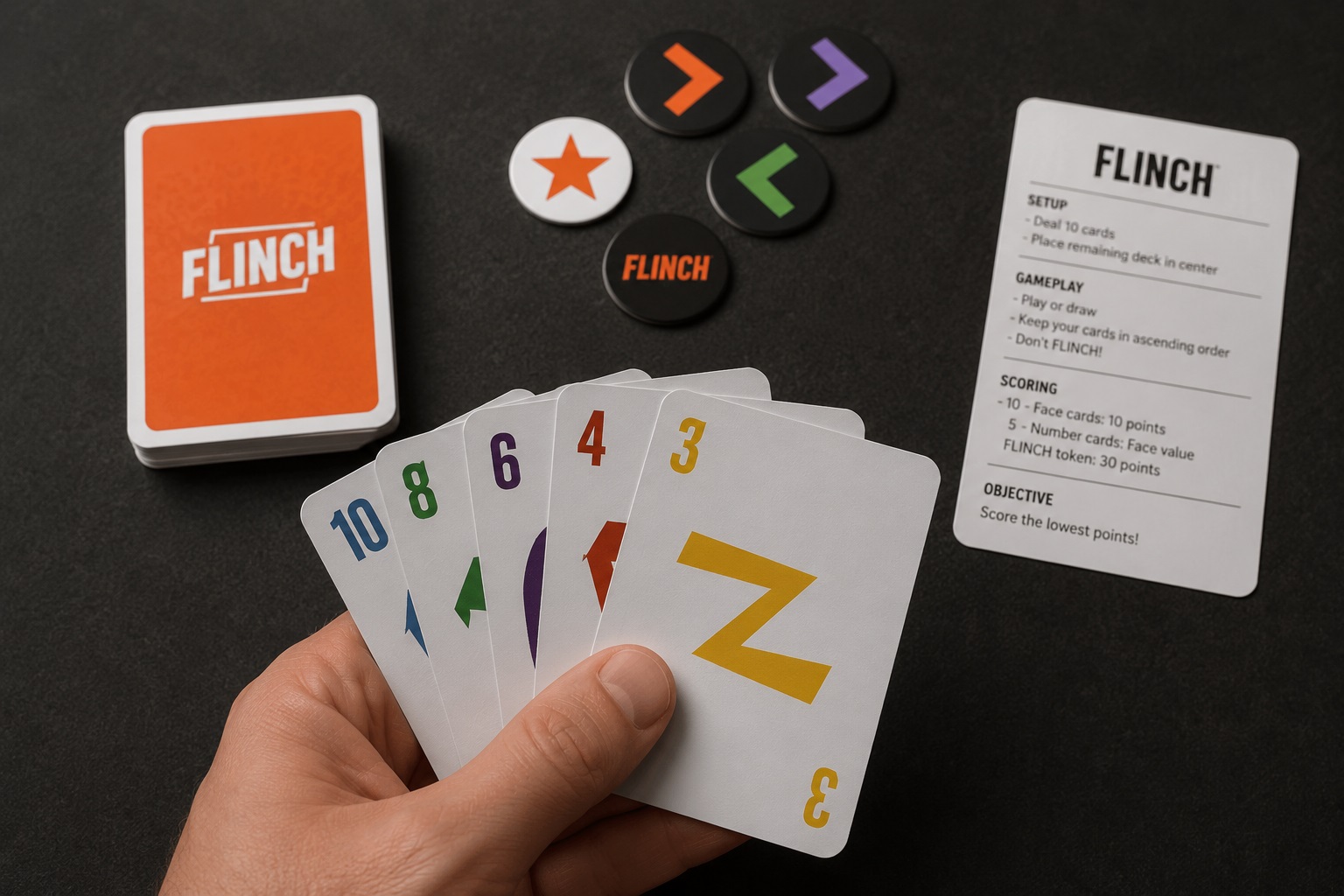
- The Classic 150-Card Deck. The original Flinch deck holds 150 cards: ten identical series, each running 1 through 15. There are no suits and no face cards, just numbers, and the digits are printed twice on each card so anyone around the table can read them upside down. That tiny design choice tells you the game was built for a crowd sitting on all sides of a kitchen table, not for a single player fanning a hand.
- The Modern 144-Card Deck & Wild Cards. The version Winning Moves sells today usually contains 144 cards — nine of each number from 1 to 15, plus nine wild cards. Some retail boxes ship as three smaller decks totalling 144, which is handy if you want two games running at once. The wilds are the real change. They let the publisher introduce a faster format (covered under variants) and they smooth out the bad luck of a stockpile clogged with high numbers, which is the single most common reason a classic game drags.
Can you play Flinch with a regular deck? Sort of, and badly. Two standard 52-card decks give you the numbers but not the distribution, so the rhythm feels off and the reserve-pile math stops working cleanly. The custom deck is doing quiet work that a poker deck cannot replicate.
What makes Flinch interesting is how it turns a simple race to empty your stockpile into a game of timing, memory, and careful risk-taking. That same attention to rules and smart decision-making also applies when exploring online gaming options, where players should look closely at bonuses, limits, and payment terms before getting started. Canadian readers can use CUMTN as a practical guide to comparing online casinos, payment methods, and promotional offers.
Key Terms You Need to Know
Read these once and the rest of the rules will move quickly.
- Stockpile (sometimes called the Flinch pile or game pile): the ten-card stack dealt face down in front of you. Only the top card is turned up, and emptying this pile is how you win.
- Hand: five cards you hold privately and refresh from the stack.
- Stack (the draw pile): every card not dealt into stockpiles or hands, laid out in the centre in small crisscrossed groups of five.
- Play piles: the shared piles built up 1 to 15 in the middle of the table. Everyone plays onto them.
- Reserve piles: up to five personal discard stacks in front of you, built one card at a time, where only the top card is ever playable.
The split between the shared play piles and your private reserve piles is the whole tension of the game, so keep those two straight.
How to Set Up Flinch
- Pick a dealer and shuffle the full deck.
- Deal ten cards face down to each player. That is the stockpile. Everyone flips the top card face up.
- Deal five more cards to each player as their starting hand.
- Stack the remaining cards in the centre, split into crisscrossed groups of five, as the draw stack.
- The player to the dealer’s left goes first.
Lay your reserve-pile space clear in front of you before the first turn. New players almost always crowd their reserve piles into their stockpile and lose track of which is which, then get caught by a challenge they could have avoided.
How to Play Flinch
The Goal of the Game
Empty your stockpile before anyone else does. Every other rule bends toward that one objective, and it is easy to forget mid-game when you are happily dumping cards from your hand that do nothing for your stockpile.
Playing Cards in Sequence (1 → 15)
Play piles always start with a 1 and build upward one number at a time. A 2 goes on a 1, a 3 on a 2, and so on until a pile reaches 15 and gets cleared away. Any 1 you can play, you must play — they are the only mandatory cards in your hand, and they start the piles everyone else needs.
Using Your Hand, Stockpile & Reserve Piles
On your turn you can feed a play pile from three sources: the top of your stockpile, your hand, or the top of any reserve pile. Here is the rule that catches people: if the top card of your stockpile can legally go onto a play pile, you have to play it. Hand and reserve cards are optional, your stockpile is not. When you finish playing, you cap the turn by moving one card from your hand onto a reserve pile, then play passes left.
Drawing & Refreshing Your Hand
Empty your hand and you immediately draw a fresh group of five from the stack and keep going. A good turn can chain through several refreshed hands before it ends, which is where the game suddenly stops feeling slow.
When the Stack Runs Out
Completed play piles — the ones that reached 15 — get shuffled back together to form a new stack. The game cannot truly run dry as long as piles keep completing, so a stalled table is usually a standoff of will, not a shortage of cards.
The Flinch Rule
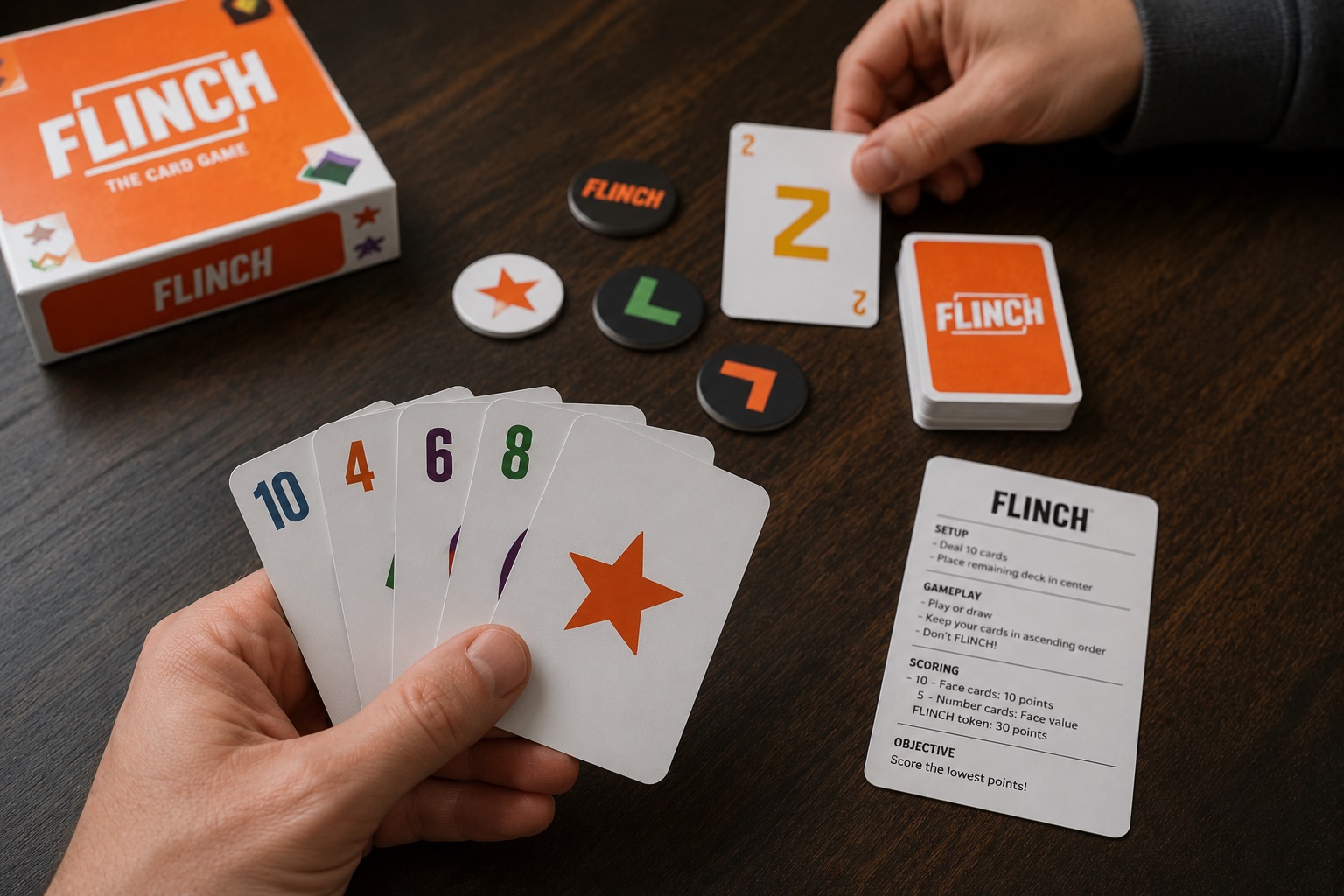
The game is named after a penalty, and that tells you how central it is. If the top card of your stockpile can be played and you fail to play it, any opponent can shout “Flinch!” The moment they do, your turn ends, you draw the top card from that opponent’s stockpile, and you bury it at the bottom of your own. You just got handed an extra card on the exact pile you are trying to empty. That is a real swing.
You can also challenge someone for sitting on a 1 in their hand when they should have played it. Get the challenge right and they take the penalty card; get it wrong and the penalty bounces back onto you, so a fishing-expedition challenge can cost you the game. If two players yell at once, the one nearest the offender’s left gets the credit.
A note that trips up newcomers: revealing a card by accident counts. Flash a card from your hand and you must try to play it; expose one during someone else’s turn and you owe it at the start of yours. Sloppy handling loses games here as surely as bad luck does.
How to Win at Flinch
Most of a Flinch game is decided by the cards, and anyone who tells you otherwise has not lost to a stockpile of nothing but 12s and 14s. But between two players with comparable luck, the better operator wins, and the edge lives almost entirely in two places.
Managing Your Reserve Piles
Your five reserve piles are the only part of the board you control, and you build them by stacking descending cards under cards you can play. Drop a 9 onto a 10 and you can later play the 10, then immediately play the 9 underneath — a two-for-one off a single pile. Pile high cards on high cards and you bury yourself; pile in sequence and you build little ladders that fire on later turns. As the piles grow you also have to remember what is hiding underneath, since you are not allowed to look. Players with a sharp memory have a genuine, repeatable advantage.
When to Hold Cards vs Play Them
The temptation is to dump every legal card. Resist it. A card that only helps your opponents reach their stockpile cards is a card you should sit on, even when you could play it. Before you advance a play pile, ask whether the next number up sits on top of a rival’s stockpile or reserve. If it does, you may be opening the door you are trying to close.
Blocking Opponents
Standoffs happen because everyone is sitting on the same logic at once, and the table freezes until someone is forced to break it. Reading those moments — knowing whose turn the freeze actually helps and steering the piles so it lands on the player ahead of you — is the closest Flinch comes to deep strategy.
Luck vs Skill in Flinch
Flinch leans toward luck more than chess players will enjoy and more toward skill than its critics admit. The stockpile you are dealt sets your ceiling; how you use your reserve piles and your patience decides whether you reach it. Treat it as a light game with a real decision or two per turn, and it holds up far better than its age suggests.
Flinch Variants & House Rules
The deck has collected house rules for over a century, and a few are worth keeping.
| Variant | What changes | Best for |
|---|---|---|
| Fast Flinch (official) | Uses 1–13 plus nine wild cards, four reserve piles instead of five, and the Flinch penalty is dropped | Quicker games and larger groups of five or six |
| Build down from 15 | Piles start at 15 and descend to 1 | A change of pace once the standard game feels automatic |
| Build from 8 | Piles start on an 8 and grow in both directions | Sounds clever, plays muddier — try it once |
| Partner play | Teams share access to each other’s stockpiles and reserve piles | Four players who want cooperation over a free-for-all |
Fast Flinch is the one to know, because it is the format the wild cards were added for. Dropping the challenge penalty and trimming to four reserve piles takes a chunk of the tension out, but it also takes out most of the downtime, which is the trade larger groups will happily make.
Other Games You Can Play With a Flinch Deck
Because the deck is just numbers 1 to 15 in quantity, the box has long doubled as a small games library. The Flinch Card Company even sold a second game, Roodles, off the back of the same idea.
- Muggins: a draw-and-play race where you build onto centre piles and onto other players’ stock piles, with its own “Muggins!” penalty for missed plays. The closest cousin to Flinch itself.
- Authors: a set-collection game in the family of Go Fish, where you ask opponents for numbers and try to assemble books of four.
- Patience (solo): a one-player sequencing puzzle using four 1–15 series, closer to traditional solitaire than to competitive Flinch.
- Go to the Store: another asking-and-collecting game, lighter and aimed at younger players.
Flinch vs Skip-Bo vs Spite and Malice vs Dutch Blitz
These four get mentioned together constantly and rarely actually compared, so here is the side-by-side.
| Game | Deck | Wild cards | Players | Lineage |
|---|---|---|---|---|
| Flinch | 150 (or 144 modern) custom, 1–15 | In modern editions only | 2–8 | One of the earliest, 1901 |
| Spite and Malice | Two standard 52-card decks plus jokers | Jokers act as wild | 2 | Early relative of Flinch |
| Skip-Bo | 162 custom cards, 1–12 | Yes, built in | 2–6 | Later, mass-market descendant |
| Dutch Blitz | Four custom 40-card decks | No | 2–4 | Later, real-time and frantic |
The thing the table cannot show is how different they feel. Flinch and Spite and Malice are turn-based and quietly tactical. Skip-Bo is the same idea with the edges sanded off for family play. Dutch Blitz throws out turns entirely and turns the whole thing into a speed contest where everyone plays at once. Same DNA, four very different evenings.
The History of Flinch
The familiar story goes like this: in 1901, Arthur J. Patterson, a bookkeeper at a Kalamazoo stationery store called Beecher & Kymer, was playing cards at home on Vine Street and dreamed up a game with a custom deck he would print and sell. He registered the copyright that year, the firm took on his name as Beecher, Kymer & Patterson, and the Flinch Card Company was born. By 1903 the game was a national craze. Stores hung signs reading “No Flinch Today” when they sold out. Close to a million sets moved in 1903 alone.
The tidy version leaves out a man named Eugene H. Munger, who appears to have devised a game called Flinch back in the 1890s and even had it published, without success, by Selchow & Righter of New York. When Patterson built his hit, Munger’s widow held a claim, and the matter was settled in 1902 when the company bought the rights. A court later sidestepped the question of who truly owned the trademark. So the honest answer to “who invented Flinch” is that Munger may have devised it and Patterson unquestionably made it work — which is also why you will see the date given as 1893, 1901, 1903, and even 1905 depending on the source.
Each date is measuring something different. 1893 points to Munger’s early version. 1901 is Patterson’s first copyright. 1903 is when the Flinch Card Company copyrighted it and the craze took off. The 1905 you see on modern boxes is Winning Moves’ marketing shorthand. None of them is wrong; they are just answering different questions, and no competing write-up bothers to separate them.
Patterson sold the rights to Parker Brothers in 1936, by which point more than seven and a half million sets had sold. He died in 1948. The game passed down the chain of owners and is published today by Winning Moves Games USA, who keep the original card design largely intact while adding the wild cards and the Fast Flinch format. A game invented before powered flight is still in print, which is its own quiet argument for the design.
Where to Buy Flinch Today
New copies come from Winning Moves Games USA and turn up on Amazon and at most board-game retailers, usually as the standard boxed deck with wild cards and the illustrated rules for several variants. Prices sit in normal card-game territory, so if a listing is asking the better part of a hundred dollars, it is gouging on a game you can find cheaper with one more click.
Vintage Flinch is a separate hobby. Parker Brothers boxes and early Flinch Card Company sets show up regularly on eBay, and condition drives the price more than age does — a clean early box with all 150 cards and the original sleeve is the one collectors chase. For playing, buy new; for collecting, buy the box, not the year on the lid.